
Australia’s housing market is grinding to a halt – and our Budget changes are making it worse
For years we’ve been told Australia’s housing affordability crisis is caused by greedy property investors, negative gearing and the capital gains tax discount.
Now the Federal Government has moved to significantly wind back those incentives, supposedly to make housing more affordable for everyday Australians.
The problem?
The early signs suggest the exact opposite may be happening.
Instead of stimulating the housing market and improving affordability, confidence is evaporating, investors are stepping back, building approvals are slowing and Australia’s housing market has entered its ninth downturn in the past 30 years.
As someone who has spent more than two decades helping Australians finance property, I believe we’re witnessing something far more concerning than a normal property cycle.
We’re watching government policy collide with economic reality.
Confidence is the oxygen of the property market
Property markets don’t simply run on interest rates.
They run on confidence.
Confidence from home buyers.
Confidence from developers.
Confidence from builders.
And perhaps most importantly, confidence from investors who provide the overwhelming majority of Australia’s rental housing.
Over the past two months, that confidence has been severely shaken.
Following the Federal Budget announcements, investors are now facing:
- Significant changes to Capital Gains Tax from July 2027.
- Negative gearing being restricted to new residential builds.
- Ongoing uncertainty around how these policies will ultimately operate.
- Higher borrowing costs.
- Continuing construction cost pressures.
- The removal of Self-Managed Superannuation Funds (SMSF’s) from being able to buy a residential investment property post 10th of August, 2026
Whether you agree with these policies politically is almost beside the point.
Markets hate uncertainty.
And uncertainty causes people to stop making decisions.
That’s exactly what we’re beginning to see.
Australia’s ninth housing downturn
According to Domain, Australia has officially entered its ninth housing downturn in the past three decades. History tells us property markets always move in cycles, but this downturn is unique because it isn’t being driven solely by higher interest rates.
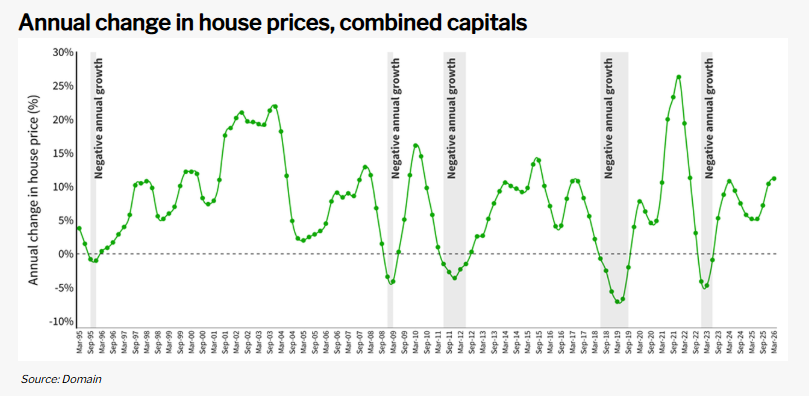
Government policy is now playing a significant role in changing buyer and investor behaviour.
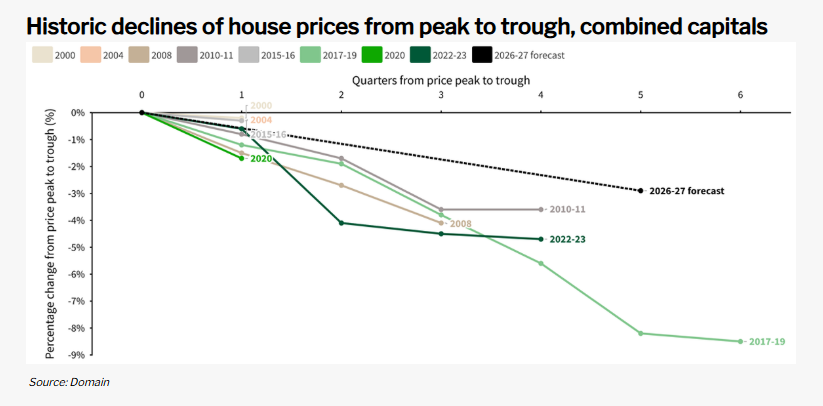
Forecasts suggest Sydney and Melbourne could experience price declines of up to 8% before the market eventually stabilises.
Some buyers may celebrate falling prices, I understand that. But falling prices don’t automatically mean housing becomes more affordable.
If lending conditions tighten, investors retreat and new housing supply falls even further behind demand, affordability can actually deteriorate over the longer term.
The contradiction that nobody seems willing to discuss
The Federal Government says it wants to build 1.2 million new homes.
I genuinely support that objective.
Australia desperately needs more housing.
But here’s where the policy starts contradicting itself.
To build more homes we need:
- investors
- developers
- builders
- finance
- confidence.
Instead, recent policy changes risk reducing investment into established housing while simultaneously assuming investors will simply redirect their money into new developments.
Unfortunately, property investment doesn’t work that neatly.
Many investors simply won’t participate.
Some will wait.
Others will move into commercial property.
Others may choose shares or entirely different investments.
The result?
Less capital flowing into residential housing.
Exactly the opposite of what Australia needs.
This is something I discussed in my earlier article on commercial property, where I suggested Budget changes could encourage a significant shift away from residential investment. Those incentives haven’t disappeared—they’ve become even more relevant.
The latest building approvals should worry everyone
Perhaps the biggest warning sign came this week.
The latest ABS figures showed total dwelling approvals fell another 1.1% in May.
That was the third consecutive monthly decline.
More concerning was what caused it.
Approvals for apartments, townhouses and higher-density housing plunged 10.4%.
Detached house approvals actually increased 2.8% and reached their strongest level since September 2021, but that wasn’t enough to offset the collapse in higher-density approvals. Overall approvals remain well below what Australia needs to meet its housing targets.
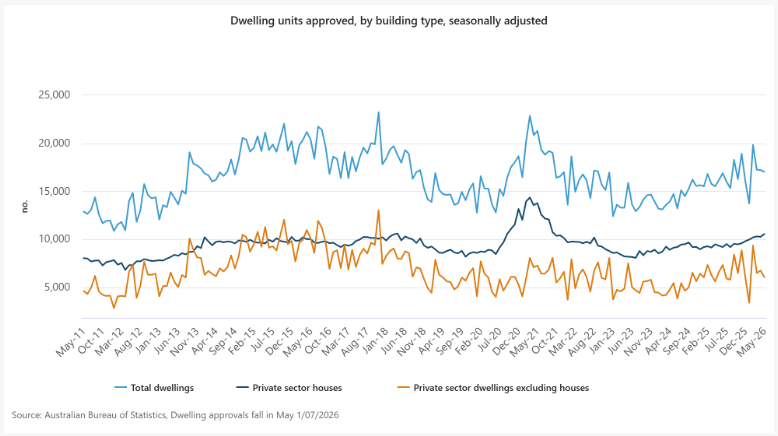
This matters because apartments and medium-density housing are exactly where much of Australia’s future housing supply must come from.
Without them, we simply cannot build enough homes.
We are falling further behind
The National Housing Accord aims to deliver 1.2 million homes by 2029.
Unfortunately, we’re already well behind schedule.
Industry estimates suggest Australia is now approximately 91,000 homes behind where it needs to be after the Accord’s first two years, with annual construction running at around 204,000 homes instead of the roughly 240,000 per year required to meet the target. (News.com.au)
That gap isn’t caused by one issue.
It’s a combination of:
- planning delays
- labour shortages
- construction costs
- infrastructure constraints
- financing challenges
- and now, weakening investor confidence.
Adding policies that discourage investment into this mix doesn’t solve the problem.
It risks making it worse.
Investors aren’t the enemy
One narrative continues to dominate the public conversation:
“If we discourage investors, first-home buyers will finally get their chance.”
I don’t believe the housing market is that simple. Investors provide most rental accommodation.
If enough investors leave, rental supply contracts.
When rental supply contracts:
- vacancies fall;
- rents rise;
- affordability worsens for tenants.
Victoria provides a recent example. Following significant state property tax changes, thousands of rental properties left the market, tightening supply and increasing rental pressure. That’s one of the reasons I warned in my previous article that reducing investment incentives could have unintended consequences.
Markets don’t respond to politics—they respond to incentives
Governments can announce policy.
Markets decide whether those policies work.
Right now, the market appears to be sending a fairly clear message.
- Developers are cautious.
- Investors are hesitant.
- Buyers are uncertain.
- Builders remain under pressure.
- Banks are becoming more selective.
None of these conditions encourage housing construction.
Where do we go from here?
I don’t believe Australia’s housing market is about to collapse.
History suggests it won’t.
Australia has endured eight previous downturns before this one. Each eventually recovered.
But this downturn feels different because many of the headwinds are self-inflicted.
The unfortunate reality is that changing tax settings doesn’t magically create more homes.
Only more construction creates more homes.
And construction only happens when people have confidence to invest.
My advice to buyers and investors
Whenever markets become uncertain, the headlines become louder.
That’s often when the best long-term opportunities emerge.
If you’re a home buyer:
Don’t panic.
Falling prices can improve negotiating power, particularly if interest rates begin easing over the next 12 months.
Knowledge Hub Updates
Join 12,400 readers who already receive it.
Andrew Mirams is the Founder and Managing Director of Intuitive Finance, a highly respected and multi-award winning Mortgage Brokerage dealing with clients all over Australia and around the world. Andrew has over 30 year’s experience in the finance industry and has assisted clients to secure over $2 Billion in mortgage lending over his time. Intuitive Finance deals with all aspects of lending from helping first homebuyers, someone wanting to upgrade their home or starting out and experienced investors looking to secure that next investment property, we can assist with all those requirements. We also specialise in working with self-employed clients and getting them the best outcomes, along with Commercial and Asset finance solutions. Intuitive Finance is highly regarded in the industry and has been recognised as a national winner of the MFAA customer service award and also one of the finance industry’s top mortgage employers. Our brokers also feature regularly in the Top 100 mortgage brokers list in Australia.